Here it is, webisode #9. Enjoy!
The link, if that doesn't show up:
http://www.youtube.com/watch?v=nIqfxpahfkg
10 July 2007


Liberation Through Education, Part One

After rising bright and early at 7:30am and chugging through my now regular morning routine (unplug computer and cameras from extension cord strung from the main house. Take extension cord into bathroom. Plug bathroom light in. Take shower. Get dressed. Go hang my towel on the line. Get stared out by entire neighborhood. Eat breakfast), Marshall (I now call him Captain) and Erin picked me up for our day of site visits in two other townships.
On our way to meet with Walter in Freedom Park, we drove through Kliptown, the township where Nelson Mandela held meetings and forums while making plans to fight against Apartheid. After Apartheid fell, big promises were made to the people of Kliptown – basic infrastructure, new schools, jobs and public spaces. Today Kliptown remains a shanty wasteland with no electricity and no running water. Port-a-potties line the dirt streets that separate the rows of corrugated steel huts. This provides the landscape for the one structure the government did build – a monument to freedom and equality.

We arrived at Freedom Park Youth Class to find hundreds of young children converging on a big green church. More than 200 preschoolers come together every Monday and Friday to participate in Walter’s “generation-gap” lessons in English, shapes, colors, numbers, days of the week and months of the year. He uses high-school aged kids as his facilitators and together, through song, dance and games they work with the tiny tots to improve their English through fun repetition activities. There are dance moves (which I learned), competitions and a “solo” section where the hot shots get to show off. After an hour-long lesson, they all head outside to groove and move while singing their enormous repertoire of songs in big circles, teachers and facilitators taking the lead.

What shocked me was how well behaved the children were! If Walter was talking, you could hear a pin drop. If a facilitator started a game, the room went silent! “Respect is rule number one,” Walter told me. Indeed, merging life skills with practical lessons seems to be at the foundation of his program. Once the preschoolers had left, Walter regrouped with the teens to talk about social issues affecting them, from HIV/Aids (the infection rate is 25% in South Africa) to teen pregnancy and safe sex. He’s found a way to empower multiple generations to teach each other while learning themselves.

From there we headed to Yeoville, another township, where we met with Denio and some of the high-schoolers she works with at a private Christian school in the neighborhood. I sat with Dineo, Daisy, Jikay, Fransisco, Everestico and MK (he said I wouldn’t be able to pronounce his actual name) for the entire afternoon talking about big issues facing them. This discussion forum is at the foundation of Dineo’s project – she wants to get young people talking about issues like sexual identity, sexual health, safe sex and HIV/Aids in an open, supportive, non-judgmental setting. Her long-term goal is to be able to train these young people as facilitators, so that they can then go out into their own communities and have these conversations, encourage exchange and educate their peers.

What I found most interesting is how different these youth were than the youth I had been around in Soweto, who attend public school (at least, when there isn’t a strike going on). They haven’t been affected by the strike. School has remained open. They took their exams. They’re gearing up for next semester. When we started talking about what motivates them, they all said the same thing: a supportive family. From there the discussion led to what society can do for those youth who don’t have that strong base at home. Answers were hard to come by. I saw looks of confusion on their faces. It wasn’t that they didn’t want to help, it was just that the idea of having no support had never entered their psyches. Indeed, it is often difficult to relate to people who aren’t in your situation, but the challenge then becomes stepping into their shoes, empathizing and as they all pointed out, not passing judgment. “This is something we all need to think about more,” Jikay told me. The group nodded in agreement. “There has to be something we can do. I’m sure of it.” That’s what this movement is about. Asking the questions that aren’t being asked. Challenging youth to think critically about their world, then supporting them when they’re ready to take action. I’m looking forward to seeing what they come up with!
On the drive home I noticed something else “missing” from everyday life – no streetlights. The boulevards were pitch black. How can you encourage positive change when your environment doesn’t even offer the basics? Let’s get those lights on, hang those street signs and install those trashcans. You’ve got to start somewhere, even if it seems too simple…
South Africa Video Up!
Alright, here it is, the South Africa short! Thanks to ease of use in terms of translations, I was able to include some first-hand interviews that are totally wonderful! South Africa is a fascinating place and I loved every minute. I hope you enjoy this sneak-peek into my time there! More blogs coming about South Africa too! Also, a big shout out to Erin Gordon for helping with the editing and production. Enjoy...
The link, in case it doesn't work:
http://www.youtube.com/watch?v=AKdiNwHyu2s
The link, in case it doesn't work:
http://www.youtube.com/watch?v=AKdiNwHyu2s
09 July 2007
Liberation Before Education
A five-week strike has crippled the education and health care sectors in South Africa. Teachers and nurses are tired of sub-par wages and inflation increases, demanding a 12% raise in salary. The government says it can’t afford that increase. The recent 200% raise for administrators, however, says otherwise. No matter which side you may agree with, the fact is that sick people and children are the ones suffering. A woman was brutally beaten to death yesterday while attempting to enter a hospital to volunteer in the maternity ward. Kids are spending their free time drinking, smoking and, as one Youth Venturer told me, “most definitely having unprotected sex” in a country with a 25% HIV infection rate.
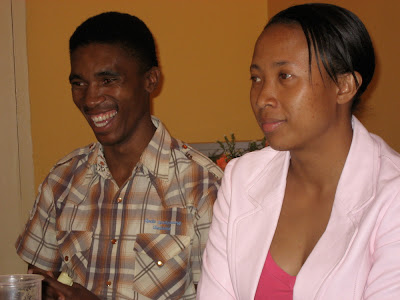
At our lunch I asked these active, engaged, educated Youth Venturers how they felt about the strike and almost all of them wanted the teachers to go back to work. “They strike and we suffer,” one of them said. “I mean, I get what they want, but they aren’t losing out on anything. We are. We are losing out on our education. Our exams. Everything.”

Before he could finish his thought one of the adults in the room – an Ashoka staff member chimed in – “Think about what you are saying. Do you really feel that way? Do you really understand the situation?” She went on to describe her generation’s struggle with Apartheid and how they were committed to “liberation before education,” knowing full-well that the only way they would be heard is if they took control, made a scene and shut down the system. “We used kids. We used young people. We rallied them in the fight because people would listen when children were involved. We did the only thing we knew how to do, which is stop everything from functioning.”
I immediately saw the tension and frustration on both sides, and how their responses represented the great generation gap that continues to grow between young people and their parents. It is true that the only outlet our parents had was to protest; make a scene; shut things down. It happened in the US with the hippie movement in the 60’s and 70’s and it happened in South Africa when young people united against Apartheid. Now, it seems that young people have more faith in the system and see value in infiltrating it. That is, creating change from the inside out. From the Venturer’s comment about not being able to go to school, what I heard was: “Now I can’t go to school and I need to go to school so I can pass exams, go to University, graduate, get into the government and change the policies myself.” It was a sense of “can do and will do,” rather than searching for some way to go against the grain.

It is also a feeling that all that protesting and frustration and shutting down isn’t productive – like there are better ways to spend their time. And maybe this is a product of the fact that the internet and cell phones have made us an “instant gratification” generation. You want to talk to someone? Call them on their cell phone! It’s always on and they’re always carrying it. Want to know something? Get on the Internet and search on Google. You’ll find 10,000 answers, all with their own angle. We are an information generation.
Do our parents and grandparents miss this? Do they “not get it?” At some level, I’d say yes, but how can we blame them? We’ve grown up with this technology as part of our everyday lives, making us experts on how the world communicates in a world run by people who are playing catch-up in the learning department.
Are young people slightly naïve? Also yes. Just in South Africa, while these youth may have access to the Internet, cell phones and a quality education in a supportive home, this is not the case for the majority.

70% of young people go home to parents who are out of work and unmotivated. 50% of kids in Soweto don’t get more than one full meal a day. I was at a soccer game only to find that most kids don’t have shoes – much less cleats – to play in. A majority were barefoot. Now, talk to that kid and ask him what options he sees for himself, or how he feels about being out of school and I’m sure the answer will be quite different. Every time M-Po and I go walking through Soweto with her son Tembo, every single person stop to stare and gawk. Out of 4 million people in Soweto, M-Po guessed that I was “probably the only White person sleeping here tonight.” Most young guys immediately start heckling her. “Found yourself a white boyfriend? Now you’re going to be rich and he is going to father your children.” Is instigating change in the government the first thing on their minds? I doubt it.
Does that mean we should stop trying? Absolutely not! Things are changing, however slow that change might be. What we need to do then, is unite these young people around something – the belief that they are empowered to create change. “We were united behind something when we were young,” An Ashoka fellow told me. “These young people, they need something that brings them together.” So then, the new mantra seems to be one of liberation THROUGH education. Liberation from poverty. Liberation from ignorance. Liberation from hunger. Yes, it would be nice if the teachers got back to work, but it would also be nice if the government paid them what they deserved. After all, they’re facilitating this new liberation, offering the means to build this movement. So maybe it’s going to a take a mix of both – signs hoisted in the air, college grads infiltrating the system. This is a fight that has to be fought on multiple fronts, and we have the power, knowledge and commitment to do that. Join us. It’s going to be a wild ride.

At our lunch I asked these active, engaged, educated Youth Venturers how they felt about the strike and almost all of them wanted the teachers to go back to work. “They strike and we suffer,” one of them said. “I mean, I get what they want, but they aren’t losing out on anything. We are. We are losing out on our education. Our exams. Everything.”

Before he could finish his thought one of the adults in the room – an Ashoka staff member chimed in – “Think about what you are saying. Do you really feel that way? Do you really understand the situation?” She went on to describe her generation’s struggle with Apartheid and how they were committed to “liberation before education,” knowing full-well that the only way they would be heard is if they took control, made a scene and shut down the system. “We used kids. We used young people. We rallied them in the fight because people would listen when children were involved. We did the only thing we knew how to do, which is stop everything from functioning.”
I immediately saw the tension and frustration on both sides, and how their responses represented the great generation gap that continues to grow between young people and their parents. It is true that the only outlet our parents had was to protest; make a scene; shut things down. It happened in the US with the hippie movement in the 60’s and 70’s and it happened in South Africa when young people united against Apartheid. Now, it seems that young people have more faith in the system and see value in infiltrating it. That is, creating change from the inside out. From the Venturer’s comment about not being able to go to school, what I heard was: “Now I can’t go to school and I need to go to school so I can pass exams, go to University, graduate, get into the government and change the policies myself.” It was a sense of “can do and will do,” rather than searching for some way to go against the grain.

It is also a feeling that all that protesting and frustration and shutting down isn’t productive – like there are better ways to spend their time. And maybe this is a product of the fact that the internet and cell phones have made us an “instant gratification” generation. You want to talk to someone? Call them on their cell phone! It’s always on and they’re always carrying it. Want to know something? Get on the Internet and search on Google. You’ll find 10,000 answers, all with their own angle. We are an information generation.
Do our parents and grandparents miss this? Do they “not get it?” At some level, I’d say yes, but how can we blame them? We’ve grown up with this technology as part of our everyday lives, making us experts on how the world communicates in a world run by people who are playing catch-up in the learning department.
Are young people slightly naïve? Also yes. Just in South Africa, while these youth may have access to the Internet, cell phones and a quality education in a supportive home, this is not the case for the majority.

70% of young people go home to parents who are out of work and unmotivated. 50% of kids in Soweto don’t get more than one full meal a day. I was at a soccer game only to find that most kids don’t have shoes – much less cleats – to play in. A majority were barefoot. Now, talk to that kid and ask him what options he sees for himself, or how he feels about being out of school and I’m sure the answer will be quite different. Every time M-Po and I go walking through Soweto with her son Tembo, every single person stop to stare and gawk. Out of 4 million people in Soweto, M-Po guessed that I was “probably the only White person sleeping here tonight.” Most young guys immediately start heckling her. “Found yourself a white boyfriend? Now you’re going to be rich and he is going to father your children.” Is instigating change in the government the first thing on their minds? I doubt it.
Does that mean we should stop trying? Absolutely not! Things are changing, however slow that change might be. What we need to do then, is unite these young people around something – the belief that they are empowered to create change. “We were united behind something when we were young,” An Ashoka fellow told me. “These young people, they need something that brings them together.” So then, the new mantra seems to be one of liberation THROUGH education. Liberation from poverty. Liberation from ignorance. Liberation from hunger. Yes, it would be nice if the teachers got back to work, but it would also be nice if the government paid them what they deserved. After all, they’re facilitating this new liberation, offering the means to build this movement. So maybe it’s going to a take a mix of both – signs hoisted in the air, college grads infiltrating the system. This is a fight that has to be fought on multiple fronts, and we have the power, knowledge and commitment to do that. Join us. It’s going to be a wild ride.
08 July 2007
This Isn’t Some Special “Africa” - My First 36 Hours In Soweto, “Jozi,” South Africa

I get off my plane, get my bag, go through customs and within minutes, I’m in a car heading to Soweto, one of South Africa’s largest townships at nearly 4.5 million people. Driving on the freeway it looks like I could be anywhere, though I have this feeling that I am at the end of the Earth. The sky looks somehow different, as if falls off at the horizon. The sun doesn’t move overhead, but more “around the side,” if that makes sense. 40 minutes later we enter Soweto, and I realize I am not just anywhere.

A haze of dust filters through the air. There are people out and about in every direction. As we move slower through the residential neighborhoods, some begin to stare at me through the window. We have yet to pass a single white person.

Every house is surrounded by a 6-foot wall that is topped with broken pieces of glass or barbed wire. There are no street signs and no public garbage cans. Trash lines the side of the street. On empty lots, large signs read “No Dumping.” No one seems to respect these signs, and how can they? After all, there are no trash cans!

We arrive at the B&B. M-Po greets us at the gate and immediately teaches me the Soweto handshake. “Shake, grab, shake, snap. There you go. You’ve got it. Now you’re a real South African,” she tells me. My room is bright and colorful, and absolutely freezing cold. I had somehow forgotten that it was the winter in the Southern Hemisphere. Sensing my chill, M-Po reassures me. “Don’t worry, the blankets are heavy.” I wasn’t worried, I think to myself. Just cold.

On the way to the big welcome lunch at Ashoka’s main office, Marshall, my driver and “protector” explains that there is no public transportation in the townships. “Everyone, if they want to go anywhere, has to take the private mini-buses. There are different hand signals to let the driver know where you want to go. If you flash their sign, they pick you up.”
The Ashoka office is located in one of the wealthiest neighborhoods of Jozi. Here, the houses are still fenced in, only the walls are 10 feet high and topped with electric fencing. At the lunch we talk about the current teacher’s and hospital worker’s strike that has kept kids out of school for more than four weeks. The teachers want a 12% raise. The government is only offering 6%. Neither side is willing to budge. Meanwhile, kids spend their days getting into trouble and not studying for exams. After the meeting I quickly use the computer. There is no internet at the B&B in Soweto. In fact, there is no internet within a 2 kilometer radius of where M-Po lives.
Marshall offers to drive me to the mall so I can buy a power converter. “It’s better if I come,” he tells me. I nip to the ATM. He stands just a foot behind me while I withdraw money. Sadly, the shop we need is closed. No computer tonight, much less internet. On the ride back to Soweto M-Po calls and texts twice, worried that I wasn’t back before dark.
Over dinner she explains that “Ten year ago, you would have been shot just for being in Soweto. Then, because you were on my land, me and my whole family would have been killed too.” On that note, I head to bed.
What can possibly be expected of people in Soweto? Unemployment is at 70% when you count every person not working. Even just counting people who are actively seeking work (like they do in the US) the unemployment rate is still 40%. There is no basic infrastructure for success – no public transportation, no street signs, no trashcans and no internet access, the key to being an active part in our global society. I feel like I have, at some level, fallen off the map and out of the World I know, even more so that when I was in Humahuaca, just 10 miles from the Bolivian border.

“Everyone thinks South Africa is the first world because there are white people living here and because of the situation in the rest of Africa,” M-Pos Director, an Ashoka fellow, told me. “It’s just not true. We may be a little better off, but our people still don’t eat. Our people still don’t work. This is Africa man. We aren’t no special case.”
07 July 2007
A Surprise Day In Frankfurt

Because of the travel *cough cough* mishap I ended up with an extra day in Germany, able to explore the wonders of Cologne with Lori Burkett, alumni swimmer from AU turned international banking superstar. She works at Commerzbank, which makes its home in Frankfurt’s tallest skyscaper. Because she’s a business professional, I met her for lunch and dinner, as well as a lightning-fast tour of downtown.

Lunch ushered in the largest cheeseburger I have ever seen, sold at a subsidized price for employees (and really good American friends of employees who get stuck in Frankfurt on their way to South Africa).

After an afternoon nap (what else was I going to do) I maintained German tradition and kept eating…and eating…and eating. In fact, Lori took me to an international food festival, where we enjoyed Thai food, German food, Italian food and even some Tacos and Crepes (from the same vendor. Hmm…). The icing on the cake was definitely the torrential downpour that happened mid-meal. While we were running from the drops, one couple decided to do a marvelous umbrella dance, of which we played witness!

One last stop at the European Central Bank (I’m an EU junkie/geek) and it was back in a taxi on my way to the airport. This was, of course, in the midst of yet another rainstorm. After checking my bags I came across an internet machine that boasted “High-speed access for only 12 euros an hour!”

The sad part is, I almost logged in to check my email again. I had just checked in 40 minutes prior and here I was doing it again. I couldn’t help myself. It was at that moment that I realized I have a problem. “My name is Kyle and I’m an emailaholic.” Luckily (I think) my internet prospects in South Africa are slim, which means I’ll need to face my problem head-on and become completely disconnected. It seems oddly freeing yet simultaneously stressful…we’ll see!
06 July 2007
My Sista Is Graduatin'!
My sister is graduating today and I am such a proud brother! Since I can't be there, I decided to make a little video of my beautiful face talking about how great she is! If you'd like to send her some personal congrats, that can be done on her myspace page at:
http://www.myspace.com/chelsdawg
Isn't she pretty? Here's the vid:
The link, in case it doesn't work:
http://www.youtube.com/watch?v=Gn5iemr1G5s
http://www.myspace.com/chelsdawg
Isn't she pretty? Here's the vid:
The link, in case it doesn't work:
http://www.youtube.com/watch?v=Gn5iemr1G5s
Subscribe to:
Posts (Atom)