A friend of mine spent a year in South Africa working with a group called Coconut Daughters on what looks to be a fascinating film about the life of an innocent girl living in a township. This is absolutely social change. Teaching, educating and exposing people to the challenges facing global society. Here is the trailer:
In case it doesn't imbed, the link:
http://www.youtube.com/watch?v=xPSJ2tbo138
Showing posts with label south africa. Show all posts
Showing posts with label south africa. Show all posts
03 October 2007


18 July 2007
Tree Housin’ It Up
Before heading to India I had a few days to hit the bush and explore the “safari” side of Africa. 8 long hours in a bus later, I arrived at Marc’s Tree House for four fun-filled days of sitting, watching and occasionally saying “stop, look, it’s a…[insert awesome animal here].” Basically, you spend 9 hours in an open-air vehicle, your eyes glued to the bushes on both sides, trying to spot that elusive lion, leopard or rhino (though my favorite animal is the giraffe, and there were lots of those, so I was a happy camper). What made the experience even more interesting for me is that I traveled alone, which meant I was surrounded by lots of new people. There was the French family who isn’t actually French [I still don’t get it] and lives in Laos part of the year and on a small island off the coast of Madagascar the rest of the year. Then there were the Mexican girls, who were all diva’ed up each and every morning. Three young Brits joined as well – Tom, Ross & Andy (how British is that?). They’re working their way up the coast of South Africa, surfing at every possible beach. Two Korean fellows were on board as well, one of them being a National Geographic Photographer. He has lived in a tent for five years traveling the world taking pictures! Of course, we had a party pooper also. I named him the “Bitter Brit.” Nothing was right – not the food, not the vehicle, not the temperature, not the other people…PARTY POOPER! Last but not least, there was Ida. Ida was more than 80 years old and, after her husband died, decided to see the world (He didn’t like to travel). She was one tough Irish lady, and we had a ball. Reminded me of my grandma. As words won’t really tell the best Safari story, I decided to make a short little video to a glorious Elton John song. Enjoy!
17 July 2007
The Best Mugging Ever

It happened, as I was told again and again it would; I was mugged in Cape Town, and it happened in broad daylight. Well, it started out as two guys mugging me and it finished with them apologizing and me giving them business cards and encouraging them to start venture teams.

I had just dropped off the stupid Mercedes that has been nothing but trouble the past three days and knew I was already a target before leaving Avis. People watched me drive that bubble car in and they watched me walk out. I moved swift and confident, but what local returns a rental car then wanders toward “backpacker land?” Exactly.
So I was walking down the street and a guy turned out of a warehouse lot, walking toward me. He was looking over my shoulder, so I followed his eyes and realized there was a guy walking about ten feet behind me. I knew immediately what was happening.
The guy in front pulled out a knife and told me to “give him all of my money.” The guy behind stood there so I couldn’t get away. Now, I’ve been robbed twice and a friend of mine who lived in Cape Town explained that it is usually possible to negotiate some arrangement where I give them my money but I get to keep my camera, phone, etc. (as if I had done something wrong in the first place – “keep” my own phone? Come on!). So, rather than be frightened I found myself irritated that I would be targeted considering the work I’m doing to help curb the situations that create thievery and so forth.
Without thinking (total gut reaction) I blurted out, “Hey man, I’m not the problem. I’m just trying to help, okay? I don’t have money to give you and if you take my camera, then I can’t do my job and I’m trying to help you and people who aren’t being taken care of. You don’t want to do this.” They were shocked, to say the least. I just kept going on and on and on about Ashoka, Youth Venture, inspiring change, empowering young people, spending time in the townships and trying to get individuals to take ownership over their communities. A good minute or two into my speech and the knife lowered.
The more I talked, the more the tension de-escalated and by the end of the whole ordeal, we were apologizing to each other for the whole thing. I learned they were only nineteen and twenty, in the city from their township because there is no work. Both their fathers left years ago and they’ve been involved with gangs, drugs and now this. I listened. I showed empathy. By the end of it all, I was giving them my business card telling them all about Youth Venture, encouraging them to get in touch with me and think about ways to improve their own lives and the lives of their friends.
I realize this story sounds totally impossible and sadly, there was no witness, except for the Avis guy who was sitting in his office watching with his mouth open while everything happened. I don’t know how my mind and body knew that was the way I should react, but it did and maybe now we’ll get some teams out of it. The moral of the story? If you’re being mugged, claim that you’re trying to help, push blame onto someone or something else and ask them if they’ve heard of Youth Venture. (I had no pictures of “the incident” so I included a photo of the horrific Mercedes that got me into deep, deep trouble. Ish…
16 July 2007
For SAGE, It Starts At Home

Since Youth Venture is new in South Africa, our reach doesn’t yet extend to Cape Town. Still, that doesn’t mean there aren’t amazing young people creating change, which is the point of this global movement. You don’t have to be a YV team to create change; the reality is, we want every person to join in by taking an active role in their own life and in the life of their “world,” whether that is defined as their street, neighborhood, city, country or the whole planet!
With this in mind Erin and I connected with an organization called SAGE that also works with you to support entrepreneurial initiative on a global level. Erin, by the way, is my incredible travel buddy who started her own venture in the US last year as part of NYU’s “Be A Changemaker” Challenge and is now working in the Youth Venture “Jozi” office while studying abroad in South Africa.

While I had heard of SAGE, I had no idea the teams we were going to meet were not only national known, but internationally recognized as well. Our first stop was Serapta Secondary School, where Giovanni, Liezelle, Colette, Bianca, Lacille, Tatum, Chevonne, Brendan and Jarroo had developed a blanket drive for the homeless that brought in more than 1000 blankets a semester, a food drive for the homeless that mobilized the entire school and community, a peer mentor program that had been institutionalized at their high school and was now spreading to other schools in South Africa and a Female Empowerment Organization called GEM that is now forming chapters in multiple countries around the world. The founders were all between the ages of 15 and 18.

What made speaking with them so interesting as that because internet penetration is abysmal in South Africa (only one of the kids even had an email address) their concept of the global scope of what they’re doing and how their project fits into a larger movement was nonexistent, which meant I got to share something entirely new while inviting them to apply for additional support from Youth Venture. Never a bad thing. This, of course, all happened after we talked about Justin Timberlake and what it’s like to grow up near Hollywood.
In search of more SAGE, we continued on to Bellville South High School. Actually, we mistakenly went to Bellville High School (we have yet to get anywhere without making at least one wrong turn. The South Africans call traffic signals robots and while they can’t tell you the names of streets, they can tell you how many “robots” there are at the sixth street off of highway N2, which is not very useful). At Bellville High School lost and looking for directions, the Assistant Principal (clearly incredibly bored) took the opportunity to draw the most detailed map I had ever seen to help us find our way. Thirty minutes later (now 20 minutes late) we were back in the Benz on our way.

Thankfully, Roselere, Robyn, Daniel, Tanya and Ernest weren’t mad that we were late, despite the fact that we interrupted “production” on their new line of bookmarks and candle holders made entirely of recycled materials. In fact, these entrepreneurs design, develop and build more than a dozen “goods” that are then sold in the community at a responsible price, using the money raised to fight social problems in their communities. This now-international social company has revitalized the community and the school while offering a creative outlet for teens who have too much time on their hands and find themselves slipping into bad habits, like drug use and having unprotected sex.

This powerhouse LLP aint’ no bake sale – they finished fourth in the world at SAGE’s annual project competition, held last year in Shanghai, China (which meant we had lots to talk about, as I lived there for the better part of a year). “The first place team was from California,” Tanya told me. “Kanye West produced a commercial for them. We did everything on our own, so we’re pretty proud of our fourth place.” So was I. There model is a shining example of how income generation isn’t a bad thing, and can instead help forward the social goals of an organization. Now in it’s third production year, the SAGE kids are stepping it up a notch. They’ll be expanding their product line and opening a second workshop in the fall. They’re also 16.
By the end of the day we had recruited another ten teams, able to offer vision, strategy and financial support to help them take their dream and do something with it. What I found most interesting is that they’re all students at public schools coming from poor families and yet, they’re still incredibly passionate about their education and their social initiatives. I asked what kept them going and all fourteen of them said the same thing – supportive parents. The real question then, is how society can help those young people who don’t have that foundation at home. No child chooses where they’re born and who their parents will be, but does that mean that if they pull a bad straw, they don’t deserve the same chance to make something of themselves? I don’t think so, which I why I believe we as a global society need to work harder to support children and youth to offer the “back-up” they need in life if someone isn’t (or can’t) offer it at home. That’s my challenge for the day – find a way to at least partially offset the void left by absent parents. In the meantime, just be in awe of what these kids are doing. I am.
14 July 2007
Break On Through To The Other Side

After another airport “situation,” Erin & I arrived in Cape Town literally as the fog was rolling onto the tarmac. Ours was the last flight allowed to land before closing the airport. I’m guessing this was my payback after months of bad luck! The car service (there is no public transportation in Cape Town that can be safely used after dark. Heck, there is hardly any that can be safely used during the day) dropped us at our guesthouse.

We both assumed it would be two bedrooms in a shared house. No sir. We, in fact, have our OWN HOUSE - two bedrooms, two bathrooms (one with tub), a kitchen, living room and screened in sun porch. Our hostess with the mostest (Lets call her Tiny) showed us around before giving us our key and explaining how the extremely complicated padlock worked on the door. “Now, what time would you like breakfast served,” she asked. Shocked that there was a served breakfast, we spouted out 9AM for no particular reason. She headed out but before she reached the door Tiny turned to say “Oh, and the whole complex is guarded by electric fence, so don’t worry about safety.” Erin and I had officially broken through to the other side. I went from one room in an electricity-less, quaint township home to my own house behind an electric fence in posh Bellville. This drastic change played loops in my mind all night.

Fast forward to this morning at 9AM, when Tiny and her trainee (we’ll call her Not So Tiny) popped in to deliver our egg and bacon omelets, toast, strawberries, yogurt, cereal, fresh fruit and an assortment of spreads. After devouring our guilty food, we agreed (with Tiny’s advice) that renting a car for three days made more financial sense. Unfortunately, neither of us could really drive stick, which meant we had to reserve the ONLY automatic at Avis, which they were going to deliver to our door at noon.

Noon rolls around and we watch out the window as a BRAND NEW MERCEDES pulls up, Avis woman hopping out in her bright red “Avis jumpsuit.” So now we’re living in our own house behind an electric fence eating omelets made for us while driving a Mercedes around. All I could think was, “Am I really in the same country?” Swinging from one extreme to the other was honestly disrupting my ability to think. Still, we had projects to visit so I signed twice, initialed seven times and promised to give Avis my first-born if the car was stolen, and we were off.
Needless to say, driving on the left side of the road while sitting on the right side of the car for an American who hasn’t been behind the wheel for months was more than entertaining. I broke on through to the other side on numerous occasions. With Erin “maps are silly, I think it’s that way” Gordon to my left, we never actually got to where we were going on the first try. Most notably, on our ride back from Cape Town to “the burbs” this evening, we missed our exit by, oh, 15 miles, ending up in a roadside garage (gas station) after accidentally running a red robot (traffic signal) looking for M15, which was conveniently NOT located between M14 and M16.
After locating said M (again, 15 miles back the way we came) I dropped the shifter into drive and made a right out of the gas station, only, I pulled into the FIRST LANE, which was on the WRONG SIDE here. The fast-moving oncoming traffic (two vans carrying 10 people each) began flashing their lights at me. I looked to the left in an attempt to veer to my side of the rode, but there was a car in the second lane coming at me as well, which left no room for a lane-change. Meanwhile, the guy in my lane is not slowing down and has decided instead to continue to move at 60 miles per hour and just flash his lights and honk his horn, as if that is going to get me to move or something.
I am now completely stopped, unable to go left because another car is coming, yelling at the guy heading straight at me to move in a desperate attempt to avoid using our front and side airbags. He’s not slowing (why, I have NO IDEA. I mean, wouldn’t you slow down?) and he’s not changing lanes, so Erin and I brace for impact, both screaming at the top of our lungs for the guy to SLOW DOWN.
He’s getting closer and closer and closer. No pace change. At this point, I’m wondering who is really at fault for this impending accident. Yes, I’m on the wrong side of the road but he could have ABSOLUTELY stopped in time. Now the van is honestly 25 feet out and I’ve basically resigned myself to the fact that we’re going to crash. Erin throws the map, as if to build a wall between her and the vehicle. 15 feet away and my hands are firmly grasping the steering wheel. I’ve pushed my head against the headrest, in hopes of avoiding whiplash. 14…13…12…11…10 feet (HONEST TO GOD) and all of a sudden the driver cranks his steering wheel and swerves around us, missing the front fender by no more than 20 inches. I turn to my left. Erin’s jaw is on the floor. I reach down to pick it up, put on my blinker and merge back onto the right (left) side of the road, as if nothing had happened.
We eventually made it back to the guesthouse and pulled the Benz behind the electric fence. All unnecessary talking had stopped post-almost-crash. As I popped the gearshift into park Erin turned to me, put her hand on mine and said “great driving today Kyle.” She was 100% sincere. Apparently she missed the whole near-death thing? Still, it would have been one dramatic way to end the World Tour, huh? Huh? Huh?
12 July 2007
One REALLY Live Earth
The party didn’t stop until 1 in the mornin’, and I have to say, I think the Joburg concert was one of the best. We got clips from other places, but ours had soul, and a lot of it. From the Soweto Gospel Choir to Zola and Joss Stone, the Coke Dome (ironic that Coke is part of saving the world) was hippity hoppin’ all night long. Highlight for me – Paully Shore, from such fine films as In The Army Now, Jury Duty & Son In Law, was in attendance to open the evening. A-MAZING! Once more, words don’t really tell the story, so I put together a short vid. Rock out. I did!
“We’re Building A Movement”

I didn’t even have to say it this time. Zaks, the leader of “Township Glory” opens every leadership training session talking about the movement. After an eggs on toast breakfast (a surprising development after two days of local cornmeal, milk and sugar fare) I grabbed my bags and the Captain (Marshall) headed for Orange Park, the home of Zaks’ program.
We left Soweto, drove through Kliptown (the shanty town) and entered Orange Farm on its one paved rode. After just a few minutes of driving we pulled off the pavement and onto a long, winding, diveted red dirt path leading into the shanty neighborhoods of Orange Farm township. The heavy winds were rustling up whirlwinds of dirt all around us. It looked as if there had been no rain in months. I couldn’t tell if this was a blessing or a curse. Of course, water would be nice, but I was unsure as to whether or not the houses would sustain even the lightest trickle of water.

“The dirt roads become rivers,” Zaks told me, as we walked down his neighbor’s car less driveway toward a makeshift church that doubled as his meeting room. I entered to find that more than twenty kids had shown up to talk about YV, the movement and their participation in “Township Glory.” The walls were covered in old newspapers. None of the window panes had glass in them.
“We’re in this room because we’re starting a movement,” Zaks begain. “We’re tired of the way things are. We want drugs and poverty and unemployment out of Orange Farm, and we’re going to do it. This is a leadership movement and you’re all at the front of it.” The room went wild! We went on to talk about how to make that change and what part they played in the global movement.

Zaks uses the arts to inspire, encourage and teach. From slam poetry to dance and theater, every kid involved plays some role. I was fortunate enough to get a special show that included original poems, traditional dance and some modern moves, on which Zak and I joined in. Lets just say I busted a move. His energy is contagious. You can’t help but get excited. Still, he wants to take it further. “I don’t want to be the only role model. I want everyone to be role models for each other, so I started a facilitator training program, to get teenagers trained to help the younger kids. It’s going well.” With his drive, I don’t know how it couldn’t be going well!

From there it was to Mofolo, where I met with Brian and about fifty youth involved in his project. He has turned an abandoned schoolhouse into a community center where kids from private and public schools come together in an environment that encourages exchange and support to reinvigorate the students in public school and give them the extra help they can’t get at home. The students in the private schools also help tutor during exam time as well as assist with University applications, making the idea of college “real” for them in a way they would have never considered otherwise.
Brian and I realized how similar our projects were, discussing ways to collaborate and learn from one another. “We take it beyond schoolwork as well,” Brain explained. “We infuse music, street culture and theater also, trying to educate both sides on their lives in a complete way.” I actually got to watch drum practice, as well as run around like a maniac playing tag with all the kids. For whatever reason, it didn’t matter who was actually “it,” the kids just chased me around.

I also ran into some fellow Americans there. The first were a group of high school students from Nobles High School in Boston. They were here for three weeks to “do service and stuff,” one girl told me. They arrived in their air-conditioned coach from their luxury hotel after flying first class to get here. My only hope is that they actually attempt to take an honest look at their surroundings and the work they’re doing, rather than just seeing it as coming to Africa and like, helping poor people. I handed out some business cards, so maybe we’ll get some projects from them. Now that would be cool!

The other American was a real character – originally from New York, he actually lives “in a shack down the road a bit,” as he explained it to me. Now thirty-three, his life goal has been to avoid the “real world” forever. Educated at Pomona College in California, he has spent the last 12 years bee-bopping the globe taking odd jobs to make time for his writing. I looked at him and in a lot of ways, I saw myself – never wanting to settle down. Then again, the whole shack down the road thing might not work for me. I wasn’t able to snap his photo, but he made me think of Chris Farley on SNL when he did the bit about “living in a van down by the river,” so I posted that picture instead. R.I.P. Chris.
From there it was to the airport, where Erin and I (Erin is an American who is interning for Ashoka in South Africa) were shuffled around to three bag-check areas and two boarding gates before actually boarding our plane. Nevertheless, we’re off to Cape Town!
10 July 2007
Liberation Through Education, Part One

After rising bright and early at 7:30am and chugging through my now regular morning routine (unplug computer and cameras from extension cord strung from the main house. Take extension cord into bathroom. Plug bathroom light in. Take shower. Get dressed. Go hang my towel on the line. Get stared out by entire neighborhood. Eat breakfast), Marshall (I now call him Captain) and Erin picked me up for our day of site visits in two other townships.
On our way to meet with Walter in Freedom Park, we drove through Kliptown, the township where Nelson Mandela held meetings and forums while making plans to fight against Apartheid. After Apartheid fell, big promises were made to the people of Kliptown – basic infrastructure, new schools, jobs and public spaces. Today Kliptown remains a shanty wasteland with no electricity and no running water. Port-a-potties line the dirt streets that separate the rows of corrugated steel huts. This provides the landscape for the one structure the government did build – a monument to freedom and equality.

We arrived at Freedom Park Youth Class to find hundreds of young children converging on a big green church. More than 200 preschoolers come together every Monday and Friday to participate in Walter’s “generation-gap” lessons in English, shapes, colors, numbers, days of the week and months of the year. He uses high-school aged kids as his facilitators and together, through song, dance and games they work with the tiny tots to improve their English through fun repetition activities. There are dance moves (which I learned), competitions and a “solo” section where the hot shots get to show off. After an hour-long lesson, they all head outside to groove and move while singing their enormous repertoire of songs in big circles, teachers and facilitators taking the lead.

What shocked me was how well behaved the children were! If Walter was talking, you could hear a pin drop. If a facilitator started a game, the room went silent! “Respect is rule number one,” Walter told me. Indeed, merging life skills with practical lessons seems to be at the foundation of his program. Once the preschoolers had left, Walter regrouped with the teens to talk about social issues affecting them, from HIV/Aids (the infection rate is 25% in South Africa) to teen pregnancy and safe sex. He’s found a way to empower multiple generations to teach each other while learning themselves.

From there we headed to Yeoville, another township, where we met with Denio and some of the high-schoolers she works with at a private Christian school in the neighborhood. I sat with Dineo, Daisy, Jikay, Fransisco, Everestico and MK (he said I wouldn’t be able to pronounce his actual name) for the entire afternoon talking about big issues facing them. This discussion forum is at the foundation of Dineo’s project – she wants to get young people talking about issues like sexual identity, sexual health, safe sex and HIV/Aids in an open, supportive, non-judgmental setting. Her long-term goal is to be able to train these young people as facilitators, so that they can then go out into their own communities and have these conversations, encourage exchange and educate their peers.

What I found most interesting is how different these youth were than the youth I had been around in Soweto, who attend public school (at least, when there isn’t a strike going on). They haven’t been affected by the strike. School has remained open. They took their exams. They’re gearing up for next semester. When we started talking about what motivates them, they all said the same thing: a supportive family. From there the discussion led to what society can do for those youth who don’t have that strong base at home. Answers were hard to come by. I saw looks of confusion on their faces. It wasn’t that they didn’t want to help, it was just that the idea of having no support had never entered their psyches. Indeed, it is often difficult to relate to people who aren’t in your situation, but the challenge then becomes stepping into their shoes, empathizing and as they all pointed out, not passing judgment. “This is something we all need to think about more,” Jikay told me. The group nodded in agreement. “There has to be something we can do. I’m sure of it.” That’s what this movement is about. Asking the questions that aren’t being asked. Challenging youth to think critically about their world, then supporting them when they’re ready to take action. I’m looking forward to seeing what they come up with!
On the drive home I noticed something else “missing” from everyday life – no streetlights. The boulevards were pitch black. How can you encourage positive change when your environment doesn’t even offer the basics? Let’s get those lights on, hang those street signs and install those trashcans. You’ve got to start somewhere, even if it seems too simple…
South Africa Video Up!
Alright, here it is, the South Africa short! Thanks to ease of use in terms of translations, I was able to include some first-hand interviews that are totally wonderful! South Africa is a fascinating place and I loved every minute. I hope you enjoy this sneak-peek into my time there! More blogs coming about South Africa too! Also, a big shout out to Erin Gordon for helping with the editing and production. Enjoy...
The link, in case it doesn't work:
http://www.youtube.com/watch?v=AKdiNwHyu2s
The link, in case it doesn't work:
http://www.youtube.com/watch?v=AKdiNwHyu2s
09 July 2007
Liberation Before Education
A five-week strike has crippled the education and health care sectors in South Africa. Teachers and nurses are tired of sub-par wages and inflation increases, demanding a 12% raise in salary. The government says it can’t afford that increase. The recent 200% raise for administrators, however, says otherwise. No matter which side you may agree with, the fact is that sick people and children are the ones suffering. A woman was brutally beaten to death yesterday while attempting to enter a hospital to volunteer in the maternity ward. Kids are spending their free time drinking, smoking and, as one Youth Venturer told me, “most definitely having unprotected sex” in a country with a 25% HIV infection rate.
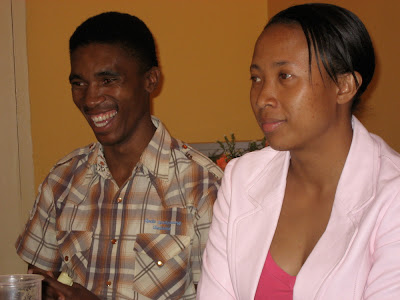
At our lunch I asked these active, engaged, educated Youth Venturers how they felt about the strike and almost all of them wanted the teachers to go back to work. “They strike and we suffer,” one of them said. “I mean, I get what they want, but they aren’t losing out on anything. We are. We are losing out on our education. Our exams. Everything.”

Before he could finish his thought one of the adults in the room – an Ashoka staff member chimed in – “Think about what you are saying. Do you really feel that way? Do you really understand the situation?” She went on to describe her generation’s struggle with Apartheid and how they were committed to “liberation before education,” knowing full-well that the only way they would be heard is if they took control, made a scene and shut down the system. “We used kids. We used young people. We rallied them in the fight because people would listen when children were involved. We did the only thing we knew how to do, which is stop everything from functioning.”
I immediately saw the tension and frustration on both sides, and how their responses represented the great generation gap that continues to grow between young people and their parents. It is true that the only outlet our parents had was to protest; make a scene; shut things down. It happened in the US with the hippie movement in the 60’s and 70’s and it happened in South Africa when young people united against Apartheid. Now, it seems that young people have more faith in the system and see value in infiltrating it. That is, creating change from the inside out. From the Venturer’s comment about not being able to go to school, what I heard was: “Now I can’t go to school and I need to go to school so I can pass exams, go to University, graduate, get into the government and change the policies myself.” It was a sense of “can do and will do,” rather than searching for some way to go against the grain.

It is also a feeling that all that protesting and frustration and shutting down isn’t productive – like there are better ways to spend their time. And maybe this is a product of the fact that the internet and cell phones have made us an “instant gratification” generation. You want to talk to someone? Call them on their cell phone! It’s always on and they’re always carrying it. Want to know something? Get on the Internet and search on Google. You’ll find 10,000 answers, all with their own angle. We are an information generation.
Do our parents and grandparents miss this? Do they “not get it?” At some level, I’d say yes, but how can we blame them? We’ve grown up with this technology as part of our everyday lives, making us experts on how the world communicates in a world run by people who are playing catch-up in the learning department.
Are young people slightly naïve? Also yes. Just in South Africa, while these youth may have access to the Internet, cell phones and a quality education in a supportive home, this is not the case for the majority.

70% of young people go home to parents who are out of work and unmotivated. 50% of kids in Soweto don’t get more than one full meal a day. I was at a soccer game only to find that most kids don’t have shoes – much less cleats – to play in. A majority were barefoot. Now, talk to that kid and ask him what options he sees for himself, or how he feels about being out of school and I’m sure the answer will be quite different. Every time M-Po and I go walking through Soweto with her son Tembo, every single person stop to stare and gawk. Out of 4 million people in Soweto, M-Po guessed that I was “probably the only White person sleeping here tonight.” Most young guys immediately start heckling her. “Found yourself a white boyfriend? Now you’re going to be rich and he is going to father your children.” Is instigating change in the government the first thing on their minds? I doubt it.
Does that mean we should stop trying? Absolutely not! Things are changing, however slow that change might be. What we need to do then, is unite these young people around something – the belief that they are empowered to create change. “We were united behind something when we were young,” An Ashoka fellow told me. “These young people, they need something that brings them together.” So then, the new mantra seems to be one of liberation THROUGH education. Liberation from poverty. Liberation from ignorance. Liberation from hunger. Yes, it would be nice if the teachers got back to work, but it would also be nice if the government paid them what they deserved. After all, they’re facilitating this new liberation, offering the means to build this movement. So maybe it’s going to a take a mix of both – signs hoisted in the air, college grads infiltrating the system. This is a fight that has to be fought on multiple fronts, and we have the power, knowledge and commitment to do that. Join us. It’s going to be a wild ride.

At our lunch I asked these active, engaged, educated Youth Venturers how they felt about the strike and almost all of them wanted the teachers to go back to work. “They strike and we suffer,” one of them said. “I mean, I get what they want, but they aren’t losing out on anything. We are. We are losing out on our education. Our exams. Everything.”

Before he could finish his thought one of the adults in the room – an Ashoka staff member chimed in – “Think about what you are saying. Do you really feel that way? Do you really understand the situation?” She went on to describe her generation’s struggle with Apartheid and how they were committed to “liberation before education,” knowing full-well that the only way they would be heard is if they took control, made a scene and shut down the system. “We used kids. We used young people. We rallied them in the fight because people would listen when children were involved. We did the only thing we knew how to do, which is stop everything from functioning.”
I immediately saw the tension and frustration on both sides, and how their responses represented the great generation gap that continues to grow between young people and their parents. It is true that the only outlet our parents had was to protest; make a scene; shut things down. It happened in the US with the hippie movement in the 60’s and 70’s and it happened in South Africa when young people united against Apartheid. Now, it seems that young people have more faith in the system and see value in infiltrating it. That is, creating change from the inside out. From the Venturer’s comment about not being able to go to school, what I heard was: “Now I can’t go to school and I need to go to school so I can pass exams, go to University, graduate, get into the government and change the policies myself.” It was a sense of “can do and will do,” rather than searching for some way to go against the grain.

It is also a feeling that all that protesting and frustration and shutting down isn’t productive – like there are better ways to spend their time. And maybe this is a product of the fact that the internet and cell phones have made us an “instant gratification” generation. You want to talk to someone? Call them on their cell phone! It’s always on and they’re always carrying it. Want to know something? Get on the Internet and search on Google. You’ll find 10,000 answers, all with their own angle. We are an information generation.
Do our parents and grandparents miss this? Do they “not get it?” At some level, I’d say yes, but how can we blame them? We’ve grown up with this technology as part of our everyday lives, making us experts on how the world communicates in a world run by people who are playing catch-up in the learning department.
Are young people slightly naïve? Also yes. Just in South Africa, while these youth may have access to the Internet, cell phones and a quality education in a supportive home, this is not the case for the majority.

70% of young people go home to parents who are out of work and unmotivated. 50% of kids in Soweto don’t get more than one full meal a day. I was at a soccer game only to find that most kids don’t have shoes – much less cleats – to play in. A majority were barefoot. Now, talk to that kid and ask him what options he sees for himself, or how he feels about being out of school and I’m sure the answer will be quite different. Every time M-Po and I go walking through Soweto with her son Tembo, every single person stop to stare and gawk. Out of 4 million people in Soweto, M-Po guessed that I was “probably the only White person sleeping here tonight.” Most young guys immediately start heckling her. “Found yourself a white boyfriend? Now you’re going to be rich and he is going to father your children.” Is instigating change in the government the first thing on their minds? I doubt it.
Does that mean we should stop trying? Absolutely not! Things are changing, however slow that change might be. What we need to do then, is unite these young people around something – the belief that they are empowered to create change. “We were united behind something when we were young,” An Ashoka fellow told me. “These young people, they need something that brings them together.” So then, the new mantra seems to be one of liberation THROUGH education. Liberation from poverty. Liberation from ignorance. Liberation from hunger. Yes, it would be nice if the teachers got back to work, but it would also be nice if the government paid them what they deserved. After all, they’re facilitating this new liberation, offering the means to build this movement. So maybe it’s going to a take a mix of both – signs hoisted in the air, college grads infiltrating the system. This is a fight that has to be fought on multiple fronts, and we have the power, knowledge and commitment to do that. Join us. It’s going to be a wild ride.
08 July 2007
This Isn’t Some Special “Africa” - My First 36 Hours In Soweto, “Jozi,” South Africa

I get off my plane, get my bag, go through customs and within minutes, I’m in a car heading to Soweto, one of South Africa’s largest townships at nearly 4.5 million people. Driving on the freeway it looks like I could be anywhere, though I have this feeling that I am at the end of the Earth. The sky looks somehow different, as if falls off at the horizon. The sun doesn’t move overhead, but more “around the side,” if that makes sense. 40 minutes later we enter Soweto, and I realize I am not just anywhere.

A haze of dust filters through the air. There are people out and about in every direction. As we move slower through the residential neighborhoods, some begin to stare at me through the window. We have yet to pass a single white person.

Every house is surrounded by a 6-foot wall that is topped with broken pieces of glass or barbed wire. There are no street signs and no public garbage cans. Trash lines the side of the street. On empty lots, large signs read “No Dumping.” No one seems to respect these signs, and how can they? After all, there are no trash cans!

We arrive at the B&B. M-Po greets us at the gate and immediately teaches me the Soweto handshake. “Shake, grab, shake, snap. There you go. You’ve got it. Now you’re a real South African,” she tells me. My room is bright and colorful, and absolutely freezing cold. I had somehow forgotten that it was the winter in the Southern Hemisphere. Sensing my chill, M-Po reassures me. “Don’t worry, the blankets are heavy.” I wasn’t worried, I think to myself. Just cold.

On the way to the big welcome lunch at Ashoka’s main office, Marshall, my driver and “protector” explains that there is no public transportation in the townships. “Everyone, if they want to go anywhere, has to take the private mini-buses. There are different hand signals to let the driver know where you want to go. If you flash their sign, they pick you up.”
The Ashoka office is located in one of the wealthiest neighborhoods of Jozi. Here, the houses are still fenced in, only the walls are 10 feet high and topped with electric fencing. At the lunch we talk about the current teacher’s and hospital worker’s strike that has kept kids out of school for more than four weeks. The teachers want a 12% raise. The government is only offering 6%. Neither side is willing to budge. Meanwhile, kids spend their days getting into trouble and not studying for exams. After the meeting I quickly use the computer. There is no internet at the B&B in Soweto. In fact, there is no internet within a 2 kilometer radius of where M-Po lives.
Marshall offers to drive me to the mall so I can buy a power converter. “It’s better if I come,” he tells me. I nip to the ATM. He stands just a foot behind me while I withdraw money. Sadly, the shop we need is closed. No computer tonight, much less internet. On the ride back to Soweto M-Po calls and texts twice, worried that I wasn’t back before dark.
Over dinner she explains that “Ten year ago, you would have been shot just for being in Soweto. Then, because you were on my land, me and my whole family would have been killed too.” On that note, I head to bed.
What can possibly be expected of people in Soweto? Unemployment is at 70% when you count every person not working. Even just counting people who are actively seeking work (like they do in the US) the unemployment rate is still 40%. There is no basic infrastructure for success – no public transportation, no street signs, no trashcans and no internet access, the key to being an active part in our global society. I feel like I have, at some level, fallen off the map and out of the World I know, even more so that when I was in Humahuaca, just 10 miles from the Bolivian border.

“Everyone thinks South Africa is the first world because there are white people living here and because of the situation in the rest of Africa,” M-Pos Director, an Ashoka fellow, told me. “It’s just not true. We may be a little better off, but our people still don’t eat. Our people still don’t work. This is Africa man. We aren’t no special case.”
06 July 2007
WE DID IT! CARBON NEUTRAL!
We did it! Carbon Neutrality has bee reached and then some just in time for LiveEarth tomorrow! Just a big thank you to the hundreds who helped to bring my emissions to zero! I needed about 38,000 pounds of carbon and received nearly 50,000 pounds. Hmm...what to do with the extra! Maybe I'll drive a suburban from South Africa to Egypt. That should do it! Just kidding! The results:

LiveEarth is tomorrow, so check out their site at www.liveearth.org and stick to those energy-reducing methods!
Thanks again!
-Kyle

LiveEarth is tomorrow, so check out their site at www.liveearth.org and stick to those energy-reducing methods!
Thanks again!
-Kyle
Subscribe to:
Posts (Atom)